
Author: Dr. William J Lossef, DDS | VP of Practice Transitions
Considering a DSO Offer?
Find out what your practice is worth before you negotiate. Our team has helped hundreds of dentists evaluate DSO deals.
Get a Free ValuationA dental support organization, or DSO, is a business entity that provides non clinical administrative and operational services to affiliated dental practices under a long term contract. Licensed dentists retain full clinical authority while the DSO handles back office work like billing, HR, marketing, IT, supply chain, and real estate.
DSOs now support more than 13,000 dental practices across the United States, and roughly one in three dentists under age 35 works in a DSO affiliated practice. If you are a practice owner thinking about growth, succession, or selling, understanding the DSO model is no longer optional.
What Is a Dental Support Organization
A dental support organization is a corporate entity that contracts with one or more dental practices to deliver shared administrative services. The DSO does not own the clinical practice and does not employ the dentists in their clinical role. Instead, a professional corporation owned by a licensed dentist owns the practice, and that PC signs a management services agreement with the DSO.
This split exists for one reason. Most states prohibit the corporate practice of dentistry, which means a non dentist cannot own a dental practice or direct clinical decisions. The DSO model works inside that legal box by separating clinical ownership (dentist owned PC) from business ownership (the DSO, which can be backed by private equity, public markets, or other investors).
People sometimes confuse DSOs with corporate dentistry, but the two are not identical. Corporate dentistry is the broader category. A DSO is one specific structure inside that category. A corporate dental brand may operate as a DSO, but a DSO is defined by its services model rather than its branding or ownership tier.
The services a DSO typically handles include patient billing and insurance claims, credentialing, accounting, payroll and HR, recruiting, compliance and OSHA training, marketing and SEO, IT support, equipment procurement, supply chain, real estate, and lease negotiation. The dentist focuses on patient care, hygiene scheduling, treatment planning, and clinical staff management.
How DSOs Are Structured
The legal scaffolding behind a DSO is called the management services organization model, often shortened to MSO. Under this model two entities operate in parallel. The first is the professional corporation or professional limited liability company, owned by one or more licensed dentists, which holds the dental license, employs the clinical team, and bills patients. The second is the DSO itself, a regular corporation that owns physical assets, signs the office lease, and provides operational services.
The two entities sign a management services agreement, usually structured as a long term contract of 20 to 40 years. The PC pays the DSO a management fee in exchange for the bundle of services. That fee is structured to reflect fair market value of the services rendered, which is the line state regulators watch most carefully.
Most large DSOs in the United States are backed by private equity. Firms like KKR, Leonard Green, Jacobs Holding, and TSG Consumer Partners have made multi billion dollar investments in the space. Private equity capital lets DSOs acquire practices, fund construction of new offices, and invest in technology that most independent owners cannot afford on their own.
The Management Services Agreement
The management services agreement, or MSA, is the contract that connects the dentist owned PC to the DSO. The MSA spells out what services the DSO provides, how the management fee is calculated, how disputes get resolved, and what happens if either party wants to exit. Most MSAs run 20 to 40 years and are difficult to unwind. When you sell to a DSO you are not just selling assets. You are signing a multi decade operating relationship, and the terms of that MSA shape your work life for the rest of your career inside the platform.
DSO vs Private Practice. The Real Differences
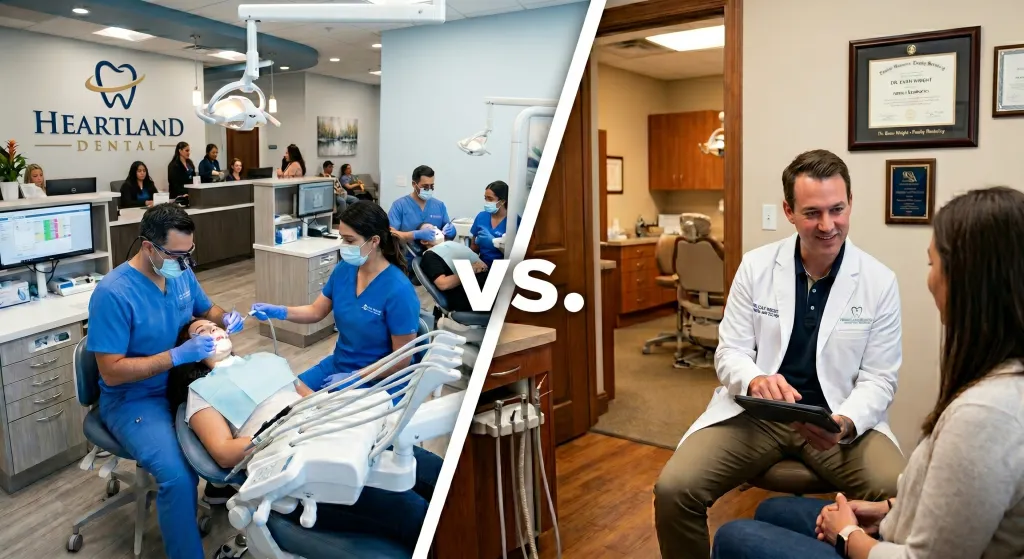
The DSO vs private practice question comes up in almost every conversation we have with sellers. The honest answer is that each model fits a different kind of dentist. Here is a side by side view of the major differences.
| Factor | Private Practice | DSO |
|---|---|---|
| Ownership | Dentist owns 100 percent | Dentist may own equity in the platform or have no equity |
| Clinical autonomy | Full | Full clinical authority, but protocols and vendor choices may be standardized |
| Capital access | Limited to SBA loans and personal credit | Backed by private equity or platform capital |
| Decision speed | Instant | Slower for non clinical decisions that route through corporate |
| Back office workload | Falls on the owner | Handled by DSO staff |
| Exit value | 2x to 4x EBITDA on average | 5x to 9x EBITDA, sometimes higher for scaled groups |
| Lifestyle | You wear every hat | You focus on clinical work and management of your office |
| Risk | Concentrated in one location | Diversified across platform, but you take on platform risk |
The two models are not better or worse. They serve different goals. A solo owner who loves running every part of the business and plans to stay independent until retirement will not gain much from a DSO. A mid career dentist who wants to grow from one office to four without taking out a second mortgage often finds the DSO model a better fit.
The exit value gap is the single biggest financial argument for the DSO model. A solo practice doing 1.2 million in collections might sell to an associate buyer for 600,000 to 800,000. The same practice, packaged as part of a DSO platform with strong systems and growth, might be valued at 1.5 million to 2 million when the platform itself sells. That spread is why so many owners think hard about DSO affiliation in their 50s.
The Largest DSOs in the United States
The DSO landscape includes hundreds of organizations of different sizes. These are 10 of the largest and most active groups operating across the country.
- Heartland Dental. The largest DSO in the United States by office count, supporting more than 1,700 affiliated offices across 38 states, headquartered in Effingham, Illinois.
- Aspen Dental. Operates more than 1,000 branded offices in 45 states, with a heavy focus on general dentistry and removable prosthetics.
- Pacific Dental Services. Supports more than 950 offices across 25 states, well known for technology adoption and a partner doctor ownership model.
- Smile Brands. Operates and supports more than 650 affiliated locations across roughly 30 states under multiple brand names.
- MB2 Dental. A doctor partnership model that operates more than 700 affiliated practices, with each partner retaining equity in their office.
- North American Dental Group. Backed by Jacobs Holding, supports more than 250 offices across 15 states under brands like Riccobene Associates and Refresh Dental.
- Dental Care Alliance. Operates more than 380 affiliated offices in 23 states, headquartered in Sarasota, Florida.
- Affordable Care. Operates more than 400 offices, with a niche focus on dentures and implant dentistry under the Affordable Dentures and Implants brand.
- Western Dental. Supports more than 300 offices across California, Arizona, Nevada, and Texas, with a strong Medicaid and pediatric footprint.
- 42 North Dental. Operates more than 100 offices across New England, formerly known as Gentle Dental.
This list shifts constantly because of mergers, acquisitions, and rebrands. Use it as a starting point rather than a final answer when you research a specific market.
Pros and Cons of Joining a DSO
The DSO decision usually comes down to which trade offs you are willing to accept. Here are the most common ones we see from owners who have gone through the process.
| Pros | Cons |
|---|---|
| Higher sale price, often 1.5x to 2x what a solo associate buyer would pay | Long contract lock in, often 3 to 5 year post sale employment commitment |
| Back office relief on HR, billing, payroll, and compliance | Loss of full autonomy on vendors, software, and some operational decisions |
| Access to capital for equipment upgrades and office renovations | Standardized KPIs and production targets you may not have used before |
| Equity rollover lets you participate in a second bite at the apple | Earnouts depend on hitting targets you do not fully control |
| Marketing, SEO, and recruiting handled by full time professionals | Culture changes that can affect long tenured staff |
| Diversification of your wealth out of a single location | You report to operations management instead of being the final voice |
The honest read is that the DSO model trades autonomy for capital, scale, and a much higher exit number. If you are not willing to give up some control, do not sign. If the lifestyle relief and financial outcome matter more than being the sole decision maker, the math often works.
Selling Your Dental Practice to a DSO
When a DSO acquires your practice, it is typically buying the assets of the practice along with a multi year employment agreement from you and sometimes your associates. The DSO does not buy your license. It buys the goodwill, equipment, leasehold improvements, patient records, and the cash flow you produce, and then signs a management services agreement with your PC.
Valuations in the DSO market generally land in a 5x to 9x EBITDA range, with the higher end reserved for practices doing more than 1.5 million in collections, with strong margins, modern technology, and a stable doctor team. Smaller solo offices in tertiary markets land at the lower end. Specialty practices like oral surgery, pediatric dentistry, and orthodontics often clear 10x EBITDA or more in competitive auctions.
Deal structure usually includes three pieces. The first is cash at close, often 60 to 75 percent of the headline number. The second is equity rollover into the DSO platform, ranging from 10 to 30 percent of total consideration, which gives you a second exit when the platform itself sells in 3 to 7 years. The third is an earnout tied to hitting EBITDA targets in the 12 to 36 months after closing. The timeline from first conversation to wire transfer typically runs 6 to 9 months.
For a deeper walkthrough of the process, deal structures, and what to negotiate, read our full guide on selling a dental practice to a DSO. If you want to know what your practice would be worth in a DSO transaction, you can find out what your practice is worth with a free valuation.
Is a DSO Right for You
The DSO question lands differently depending on where you are in your career. For a new grad dentist with student loans, working inside a DSO is often the fastest path to clinical volume, mentorship, and a steady paycheck. You skip the headache of running a business while you build your speed.
For a mid career dentist in your 40s or early 50s, a DSO can solve a specific problem. You have a strong producing practice but you are burned out on the admin side and you want to take some chips off the table without leaving dentistry. A partial sale to a DSO with equity rollover lets you de risk personally while staying clinically active.
For a dentist near retirement, the question is sharper. If you are 5 to 10 years out, a DSO sale with a strong post close employment agreement can be the cleanest exit path you have. If you are within 2 years of stopping clinical work, a traditional sale to an associate or a DSO with a short transition may be a cleaner fit.
Solo owners in rural markets sometimes find that DSOs are less interested in their offices because of recruiting difficulty and lower volume. In those cases a direct sale to a local dentist or a regional group remains the better path. Larger groups, in contrast, often field unsolicited offers from multiple DSOs every quarter. For more on the broader market dynamics, see our overview of the dental service organizations industry.
Common Questions About Dental Support Organizations
What Does DSO Stand for in Dentistry
DSO stands for dental support organization. You will sometimes see the term dental service organization used interchangeably, and both mean the same thing in practice. The label refers to the business entity that provides administrative and operational support to dental practices under contract.
How Is a DSO Different from Corporate Dentistry
Corporate dentistry is the umbrella term for any dental practice operating under a corporate or multi office structure. A DSO is one specific model inside that umbrella, defined by the legal separation between the clinical entity (a dentist owned PC) and the business entity (the DSO). Many corporate dental brands run on the DSO model, but the term corporate dentistry can also include traditional group practices and chains that are dentist owned at the top.
Who Owns a DSO
Most large DSOs are owned by private equity firms, sometimes combined with founder dentists who hold equity in the platform. A growing number are publicly traded or partially employee owned. The clinical practices that affiliate with a DSO remain owned by licensed dentists through a professional corporation, which is the structure that keeps the model compliant with state laws on corporate practice of dentistry.
Do DSOs Employ Dentists
The dentist owned PC employs the clinical team for licensing purposes. In day to day reality, dentists working inside a DSO operate under an employment or partnership agreement that functions a lot like a traditional W2 role, with production based compensation, benefits, and paid time off. Some DSOs offer equity participation that turns the dentist into a part owner of their office or the broader platform.
How Do DSOs Make Money
DSOs earn revenue through the management fee paid by each affiliated PC, which covers the cost of services and a margin on top. They also create value through scale economies on supplies, insurance contracts, and overhead, and through acquiring practices at one multiple and selling the combined platform at a higher multiple a few years later. That arbitrage between acquisition price and platform exit price is the engine that drives most private equity backed DSO returns.
Are DSOs Good for Patients
The honest answer is that it depends on the DSO and the office. Well run DSOs invest heavily in technology, infection control, continuing education, and modern equipment, which can produce a clinical experience as good or better than a solo office. Weaker DSOs push aggressive production targets that can affect treatment recommendations. As a patient, the quality of the individual office and the dentist matters far more than whether the office is DSO affiliated.
If you are thinking about a DSO sale, want a second opinion on an offer you already received, or just want to know what your practice would be worth in today's market, request a free practice valuation and we will walk you through every option, DSO or otherwise.